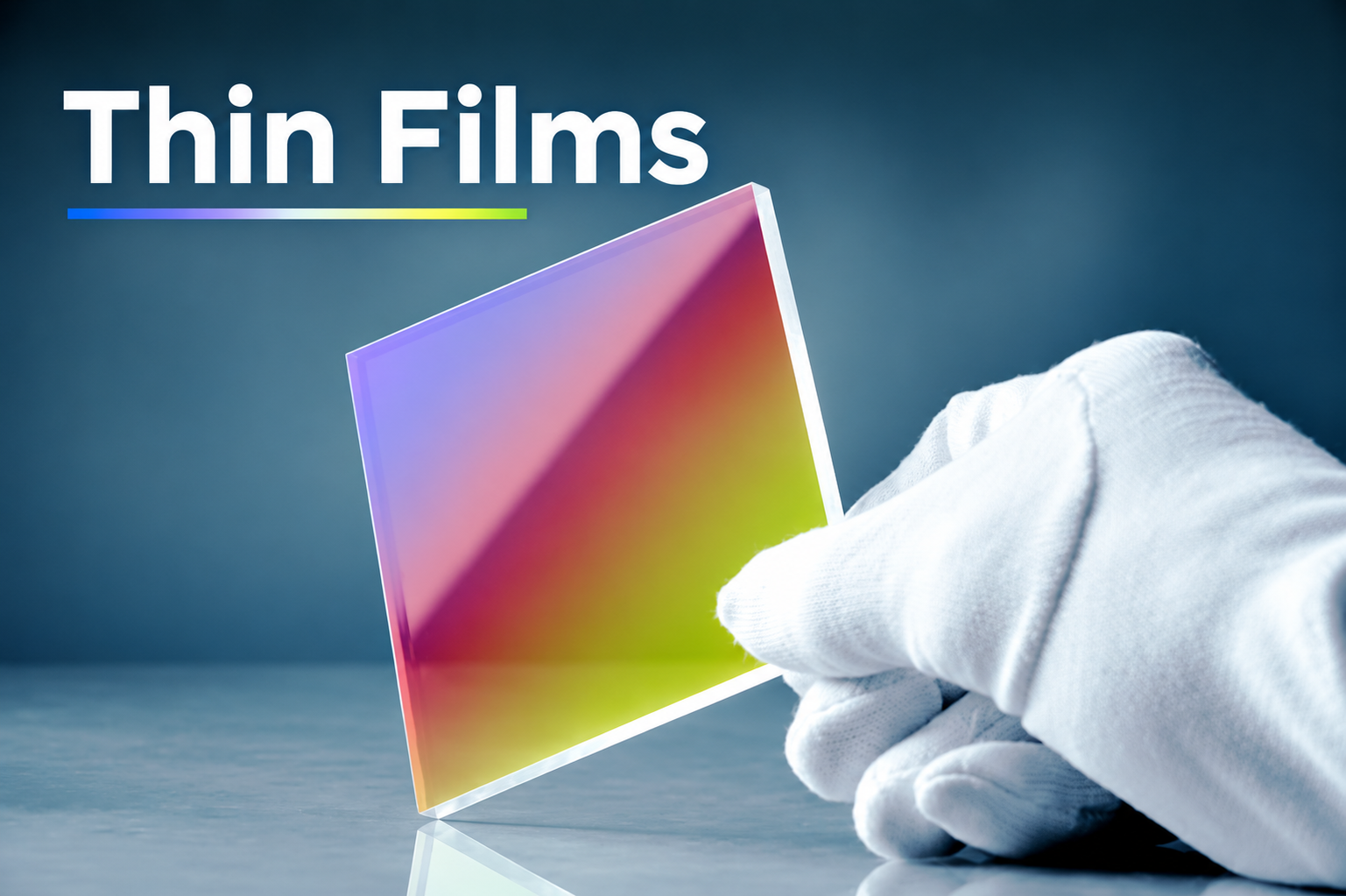
A thin film is a layer of material deposited onto a substrate, with a thickness ranging from a few nanometers to several micrometers. Thin films are widely used in microelectronics, solar cells, sensors, optical coatings, and protective coatings.
The properties of thin films depend on the deposition technique, substrate temperature, deposition time, working pressure, gas composition, and nature of the substrate.
Objective:
After completing this laboratory work on thin-film deposition, students will be able to:
-
Understand the basic principles of thin-film deposition and its applications in materials science and technology.
-
Identify the main thin-film deposition techniques, such as PVD, CVD, and spray pyrolysis.
-
Describe the different stages of the thin-film deposition process, from substrate preparation to film formation.
-
Identify the main experimental parameters that influence thin-film properties, including substrate temperature, deposition time, working pressure, and gas composition.
-
Measure and calculate film thickness and deposition rate using experimental data.
-
Understand the importance of substrate cleaning and its effect on film adhesion and uniformity.
-
Interpret basic experimental results related to thin-film thickness, morphology, and structure.
-
Relate deposition conditions to the structural, optical, and electrical properties of thin films.
- Créateur de cours: Raouia Zernadji