DATA ANALYSIS
Section outline
-
Mohamed Khider University- Biskra, Faculty of Architecture, Civil Engineering, and Hydraulics
Master's Program Title: Urban and Architectural Project Management
Academic Year: 2025/2026Course:
Data Analysis

Master 2 in Construction Projects Management
Teacher: Dr. BENDJEDIDI Souhaila
This course (DATA ANALYSIS) is intended for second-year Master’s students specializing in Construction Project Management during the third semester. In this field, data analysis plays a crucial role in enhancing planning, coordination, and performance evaluation across all stages of a project. The systematic examination of project-related data; ranging from cost estimates and scheduling information to resource allocation metrics and risk indicators, supports more accurate forecasting, strengthens decision-making, and enables more effective control over time, quality, and budget parameters. Furthermore, data-driven analysis facilitates the identification of bottlenecks, the evaluation of contractor performance, and the development of strategies to reduce uncertainty and optimize project outcomes. As construction projects become increasingly complex and data-intensive, the ability to analyze and interpret information has emerged as a key professional competency for future project managers and industry practitioners.
This course places particular emphasis on the entire analytical process, beginning with the selection of appropriate data collection strategies, followed by the preparation and management of datasets, and culminating in the application of both quantitative and qualitative analytical techniques. Throughout this process, students are encouraged to critically engage with data, assess the reliability and validity of findings, and reflect on the ethical and methodological implications of their analytical choices.
-
Title: DATA ANALYSIS
Teaching Unit: UED
Number of Credits: 1 Coefficient: 1Total Teaching Hours: 22 h 30 min
Total Weekly Hours: 1h30
Language: English
Teacher: Dr. BENDJEDIDI Souhaila
-
- Name: BENDJEDIDI Souhaila
- Academic Title/Position: Lecturer
- Department: Architecture Department
- Faculty: Faculty of Architecture, Civil Engineering, and Hydraulics
- Email: Souhaila.bendjedidi@univ-biskra.dz
- Availability for Student Consultation: Time: Sunday, 8:00 AM – 12:00 PM, Location: Studio 17
-
This course is intended for second-year Master’s students in MPC (Management of Construction Projects)

-
The course grade is based on a written exam, which lasts 2 hours and counts for 75% of the final grade, and an online Moodle exam, which lasts 1 hour and counts for 25% of the final grade.
-
-
Synchronous online sessions: 1 hour and 30 minutes via Google Meet.
-
Individual study time: Approximately 1 hour per lesson.
Individual study time is dedicated to reviewing the course materials, consolidating the concepts explained during the online session, and revising the examples provided in the lesson.
The total estimated learning time is approximately 2 hours and 30 minutes per lesson.
-
-
At the end of the semester, the student will be able to carry out research work and master the entire process covering the different stages, from data collection and analysis to report writing and decision-making.
-
At the end of the course, the learner will be able to:
- Conduct the data collection process
- Design and structure a questionnaire.
- Analyze and interpret information.
- Write a clear and structured report.
- Make informed decisions based on data.

-
Students are expected to have knowledge in:
- Mathematics
- Statistics
- Word processing (Word, Excel, etc.)
- Language proficiency

-
-
-
If you have difficulty completing this test, I recommend reviewing the following learning resources to refresh your knowledge of the basic concepts of data analysis. These resources will help you strengthen your understanding and prepare for the course.
-
-
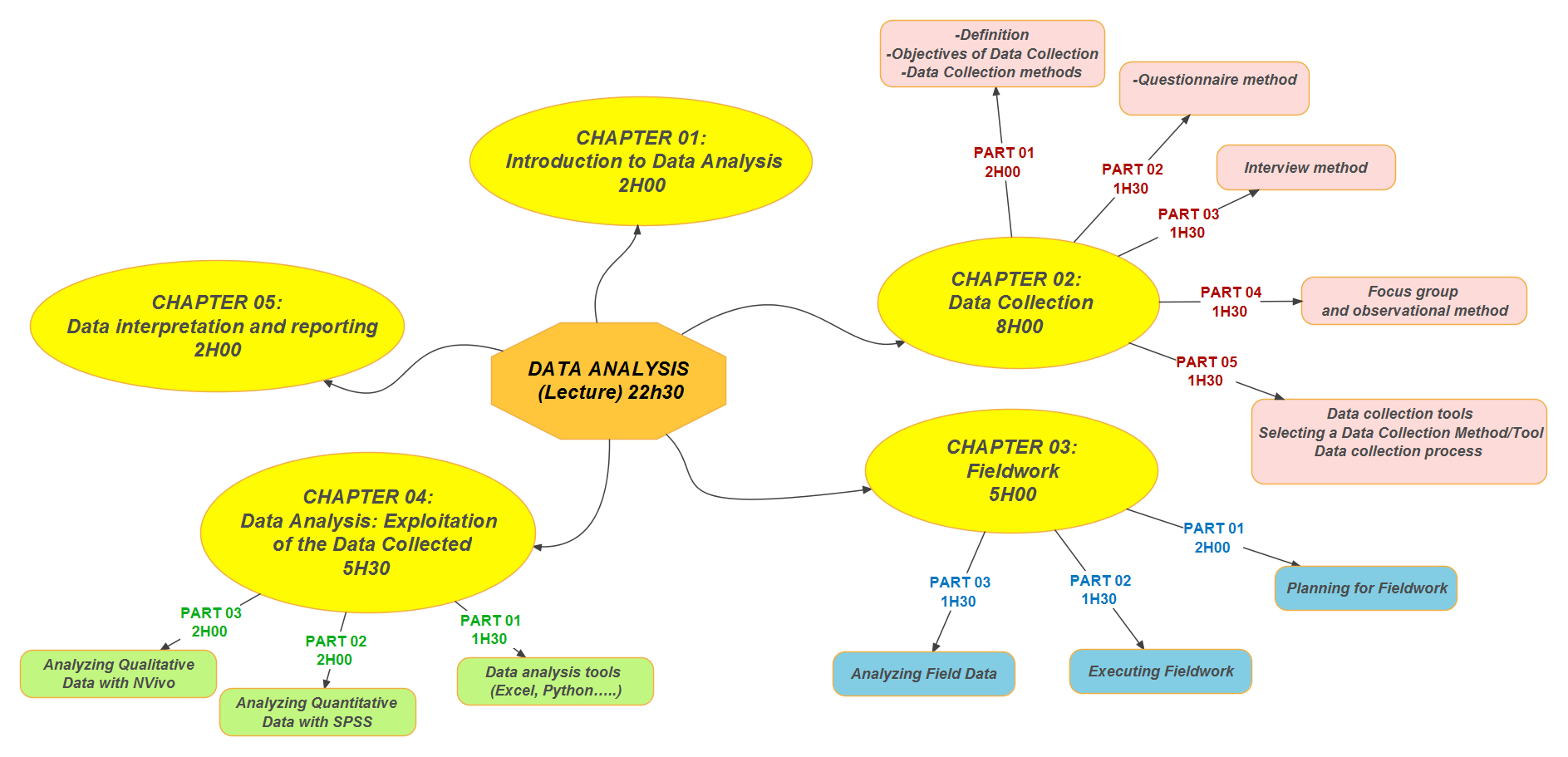
Week 01
Chapter 01: Introduction to Data Analysis
Week 02
Chapter 02: Data collection (Part 01)
- Definition
- Objectives of Data Collection
- Data Collection methods
Week 03
Chapter 02: Data collection (Part 02)
- Questionnaire method
Week 04
Chapter 02: Data collection (Part 03)
- Interview method
Week 05
Chapter 02: Data collection (Part 04)
- Focus group and observational method
Week 06
Chapter 02: Data collection (Part 05)
- Data collection tools
- Selecting a Data Collection Method/Tool
- Data collection process
Week 07
Chapter 03 : Fieldwork (part 01)
· Planning for Fieldwork
Week 08
Chapter 03 : Fieldwork (part 02)
· Executing Fieldwork
Week 09
Chapter 03 : Fieldwork (part 03)
· Analyzing Field Data
Week 10
Chapter 04 : Data Analysis: Exploitation of the Data Collected (Part01)
· Data analysis tools (Excel, Python…..)
Week 11
Chapter 04 : Data Analysis: Exploitation of the Data Collected (Part02)
· Analyzing Quantitative Data with SPSS
Week 12
Chapter 04 : Data Analysis: Exploitation of the Data Collected (Part03)
· Analyzing Qualitative Data with NVivo
Week 13
Chapter 05: Data interpretation and reporting
-
Dear Students,
Please be informed that the online lesson will take place every Saturday from 8:00 AM to 9:30 AM via Google Meet. Make sure to join the session on time using the link provided on the platform.Your presence and active participation are important to ensure effective learning. Any updates or changes will be communicated through Moodle.
-
Chapter objectives:
At the end of the course, the learner will be able to:
- Recognize the significance of data analysis and its importance for managing construction projects.
- Make a distinction between quantitative and qualitative data
- Learn about the steps involved in data analysis.
- Recognize several examples of data analysis in construction projects management domain.

-
Opened: Saturday, 4 October 2025, 8:00 AMClosed: Saturday, 25 October 2025, 8:00 AM
-
Chapter objectives:
At the end of the course, the learner will be able to:
- Understand what data collection is and why it is important for research and decision-making.
- Differentiate between data collection methods (Primary and secondary data collection )
- Learn about the tools used to gather data and how to select the best ones for specific data needs.
- Become familiar with the steps involved in collecting data properly.

-
Opened: Saturday, 18 October 2025, 9:30 AMClosed: Saturday, 8 November 2025, 8:00 AM
-
Chapter objectives:
At the end of the chapter, the learner will be able to:
- Understand the Concept of Fieldwork and its importance in data analysis
- Define Clear Objectives for Fieldwork that align with the overall goals of a project or research.
- Discover and Understand the Phases of Fieldwork: From Planning to Analysis

-
Opened: Saturday, 25 October 2025, 9:30 AMClosed: Saturday, 8 November 2025, 8:00 AM
-
-
Opened: Saturday, 29 November 2025, 8:30 AMClosed: Saturday, 29 November 2025, 9:30 AM
-
-
Opened: Saturday, 6 December 2025, 8:30 AMClosed: Saturday, 6 December 2025, 9:30 AM
-
Chapter objectives:
• Explore how to convert raw data into actionable information.
• Familiarize with various tools of data analysis (e.g.,Spreadsheet Software , Qualitative Data and Survey Tools…) to exploit data effectively.
• Learn the basics of using SPSS, including navigating its interface and utilizing its core functions for data analysis.
• Become familiar with the NVivo interface and its fundamental features for qualitative data analysis and coding.

-
Opened: Saturday, 22 November 2025, 9:30 AMClosed: Saturday, 6 December 2025, 8:00 AM
-
Chapter objectives:
At the end of the chapter, the learner will be able to:
- Define data interpretation and its importance.
- Differentiate between various data interpretation methods.
- Understand the structured steps involved in data interpretation.
- Develop skills to report interpreted data effectively using visuals and summaries

-
Opened: Saturday, 6 December 2025, 9:30 AMClosed: Saturday, 20 December 2025, 8:00 AM
-
-
If your score is 5/10 or below, I recommend reviewing the chapter materials and consulting the following resources to improve your understanding. Take time to revisit the examples, practise the exercises, and identify the areas that require further attention.
-