This course is part of the Master's program in Image and Artificial Life and aims to introduce students to the scientific, technological, and methodological foundations of virtual reality (VR), as well as its links with augmented reality. Its objective is to raise students' awareness of the current challenges in this rapidly evolving field, both theoretically and practically. The course covers the fundamental concepts of virtual reality, its historical development, and its main areas of application (education, simulation, industry, medicine, entertainment, etc.). Particular attention is paid to sensorimotor channels, interaction interfaces, and the hardware and software used in immersive systems. The course emphasizes the design principles of VR applications, drawing on the fundamentals of human-computer interaction (HCI) and user-centered design. The different 3D interaction paradigms (navigation, selection, manipulation and application control) are studied, as well as the mechanisms of sensory feedback (visual, haptic, auditory) and multimodality.
- منشئ المقرر: Abd El Mouméne Zerari
Augmented Reality (AR) combines digital content with the real world in real time.
This course introduces the fundamental concepts, tools, and technologies behind AR systems.
Students will learn about tracking, rendering, interaction, and AR development frameworks.
The course also explores practical applications of AR in industry, education, and research
- منشئ المقرر: ahlem bentrah
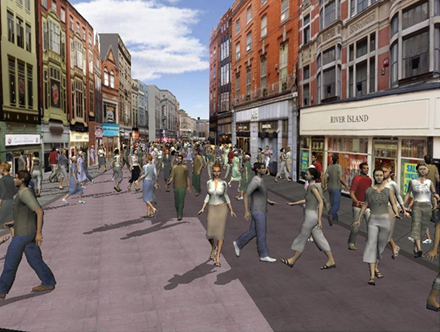
Ce cours introduit les humains virtuels, leur modélisation, leur comportement et les environnements virtuels dans lesquels ils évoluent. À travers trois grands chapitres, il propose une compréhension approfondie des concepts, des technologies et des applications dans ce domaine en pleine expansion.
- منشئ المقرر: Amina Bouguetitiche
Cette matière permet de sensibiliser les étudiants aux techniques de la vie Artificielle, qui en prenant leur inspiration sur le “vivant” permettent de construire des systèmes complexes évolutifs et adaptatifs.
Le but est de décrire facilement le comportement des acteurs évoluant dans un monde virtuel.
Ce comportement peut-être issu de différentes modalités de contrôle pour les entités (agents) dirigées ou pour les entités autonomes, par la simulation de comportements, adaptatifs et/ou coopératifs et/ou résultant d'un apprentissage.
- منشئ المقرر: Foudil Cherif
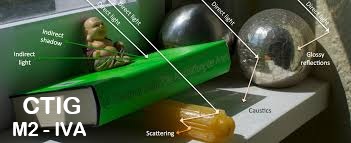
Ce module présente les principes de la colorimétrie et des techniques d’illumination globale en synthèse d’images. Il introduit la radiométrie et la photométrie, puis la modélisation de l’équation du rendu de Kajiya et ses principales méthodes de résolution : radiosité et approches stochastiques. L’échantillonnage d’importance et les techniques avancées comme le path tracing, le photon mapping et le bidirectional path tracing sont étudiés pour simuler avec réalisme le comportement de la lumière.
- منشئ المقرر: Babahenini Mohamed Chaouki