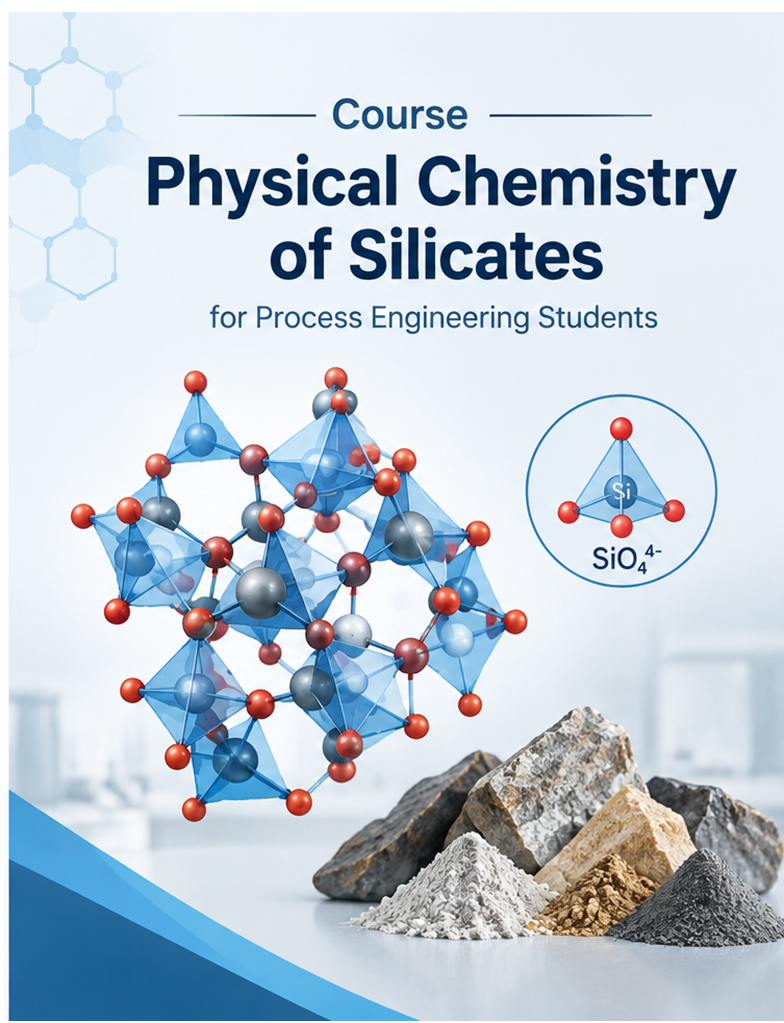
Silicates are the most abundant mineral family in the Earth’s crust and the basis of nearly all mineral-based structural materials: cements and concretes, ceramics, glasses and refractories. Understanding their behavior requires mastery of the physical chemistry that governs the transformation of matter under the effect of temperature , dissolution and precipitation, nucleation and growth, sintering, melting, clinkering; as well as the interaction of these materials with their environment (water, atmosphere) and, for hydraulic binders, their hydration.
This course follows a progression from the fundamental to the applied. We first establish the thermodynamic and kinetic tools (Chapter 1), then study the central element of this chemistry, silicon (Chapter 2), before turning to silicates and their structural classification (Chapter 3), and finally silica SiO₂ and its polymorphism (Chapter 4). At each stage, structure, microstructure and application properties are linked.
- منشئ المقرر: Rihana HADJEB