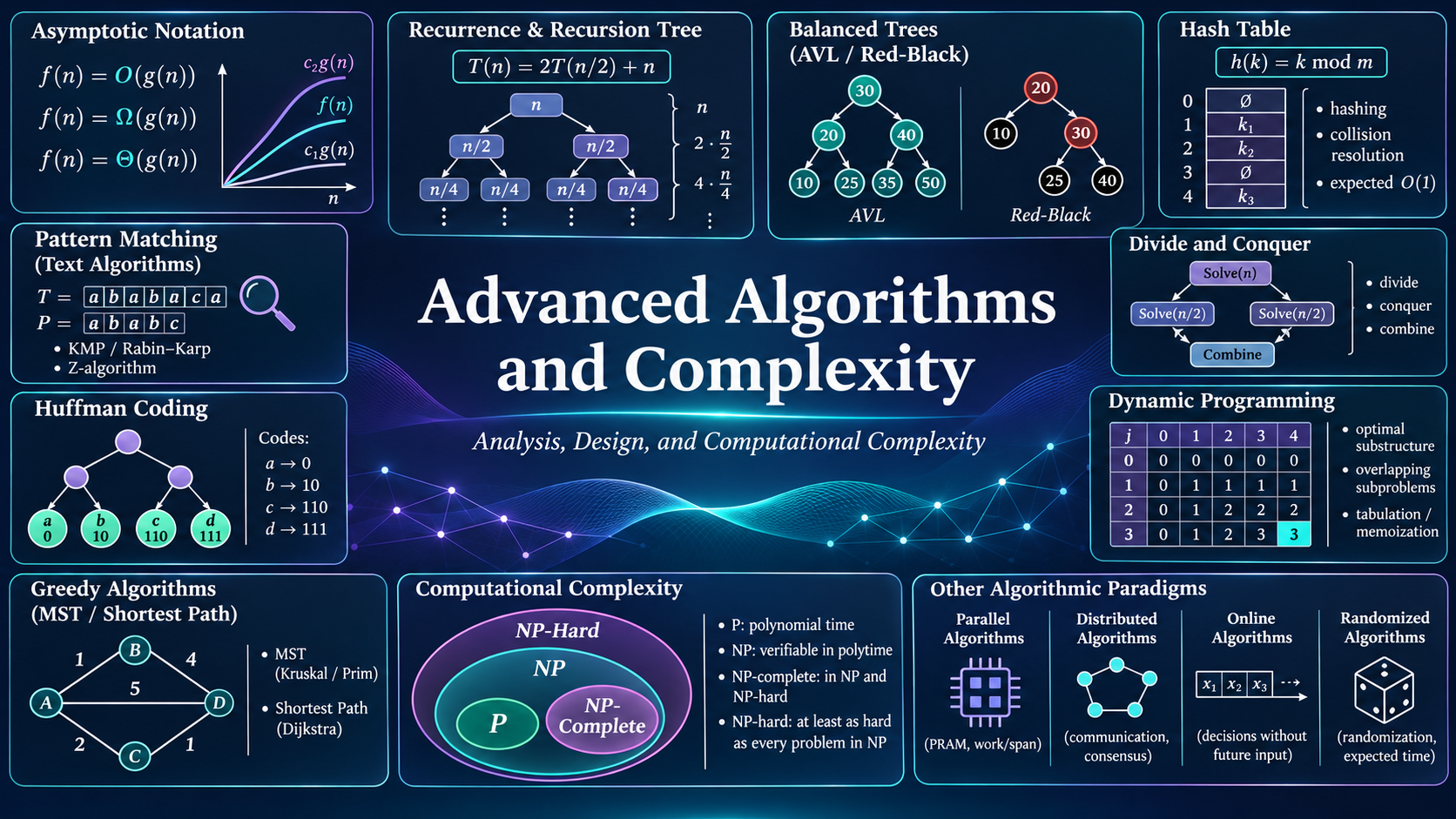
Advanced Algorithms and Complexity — Course Summary
Course duration: 21 hours
Prerequisites: Basic knowledge of algorithms and data structures.
Teaching Objectives
The course aims to give students the theoretical and practical foundations needed to analyze and design advanced algorithms. By the end of the course, students should be able to:
- understand time and space complexity;
- use asymptotic notations correctly;
- analyze algorithms in best, worst, and average cases;
- solve recurrence relations;
- understand advanced data structures and their complexity;
- apply major algorithm design paradigms;
- distinguish between polynomial and computationally difficult problems;
- understand the concepts of \(P\), \(NP\), NP-hard, and NP-complete;
- apply exact, approximate, randomized, parallel, distributed, and online methods.
- Course creator: Laid Kahloul
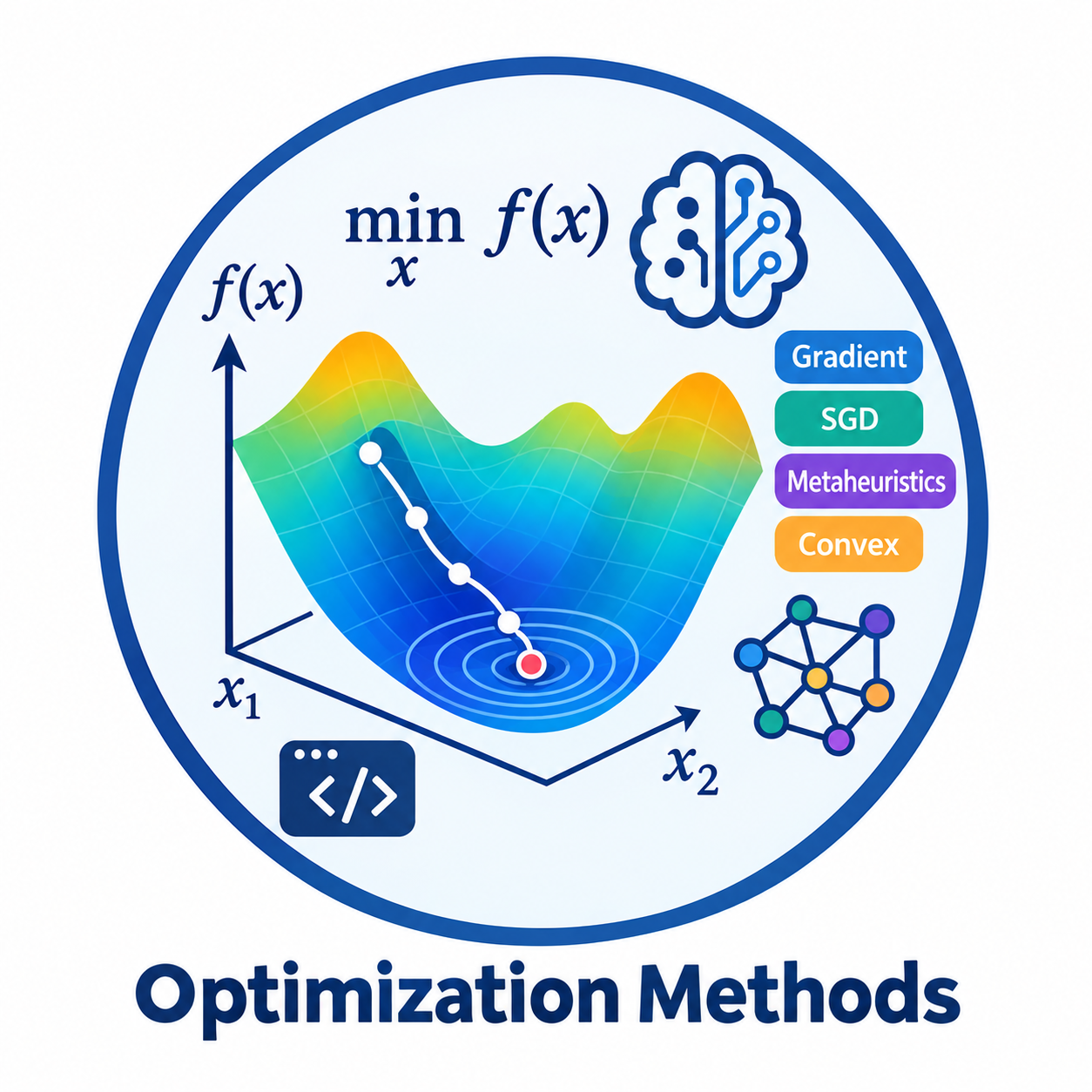
This course introduces the fundamental concepts and main techniques of mathematical optimization, with a focus on their applications in Artificial Intelligence, Visual Computing, and Computer Science. It covers the formulation and classification of optimization problems, unconstrained and constrained optimization, convex optimization, and mathematical programming. Students will study deterministic methods, including gradient descent, Newton’s method, and quasi-Newton methods, as well as stochastic optimization techniques such as Stochastic Gradient Descent (SGD) and its modern variants. The course also introduces metaheuristics and bio-inspired algorithms, including Simulated Annealing, Genetic Algorithms, Differential Evolution, Particle Swarm Optimization, and Ant Colony Optimization.
Particular attention is given to optimization applications in machine learning, deep learning, computer vision, and combinatorial optimization. Advanced topics, including distributed optimization, large-scale optimization, and the Alternating Direction Method of Multipliers (ADMM), are also introduced. Through theoretical study and practical activities, students will develop the ability to formulate optimization problems, understand the principles of optimization algorithms, and select appropriate methods to solve problems arising in Artificial Intelligence, Visual Computing, and related fields.
- Course creator: Meryem Berghida