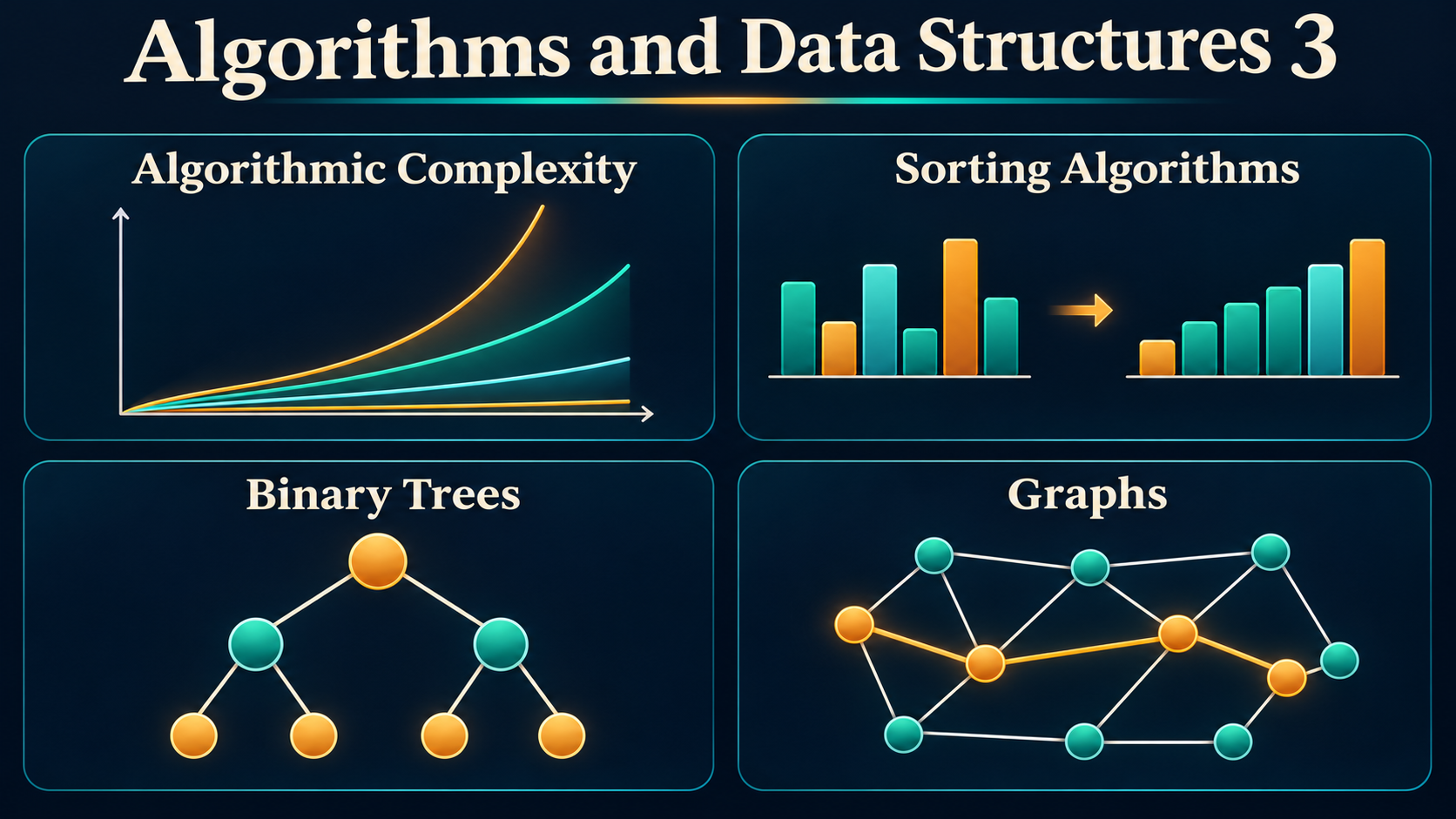
Algorithms and Data Structures 3 (6 credits, coefficient 5) builds on introductory algorithmics and teaches students to implement and analyze fundamental algorithms and work with more advanced data structures. Students begin by learning how to calculate algorithmic complexity, then implement and compare five sorting methods: bubble sort, selection sort, insertion sort, merge sort, and quicksort. They learn to convert n-ary trees into binary trees, represent binary trees using linked nodes, and perform preorder, inorder, and postorder traversals. The course also covers complete binary trees and binary search trees before introducing graph terminology, representations, and traversal methods.
- Course creator: Laid Kahloul
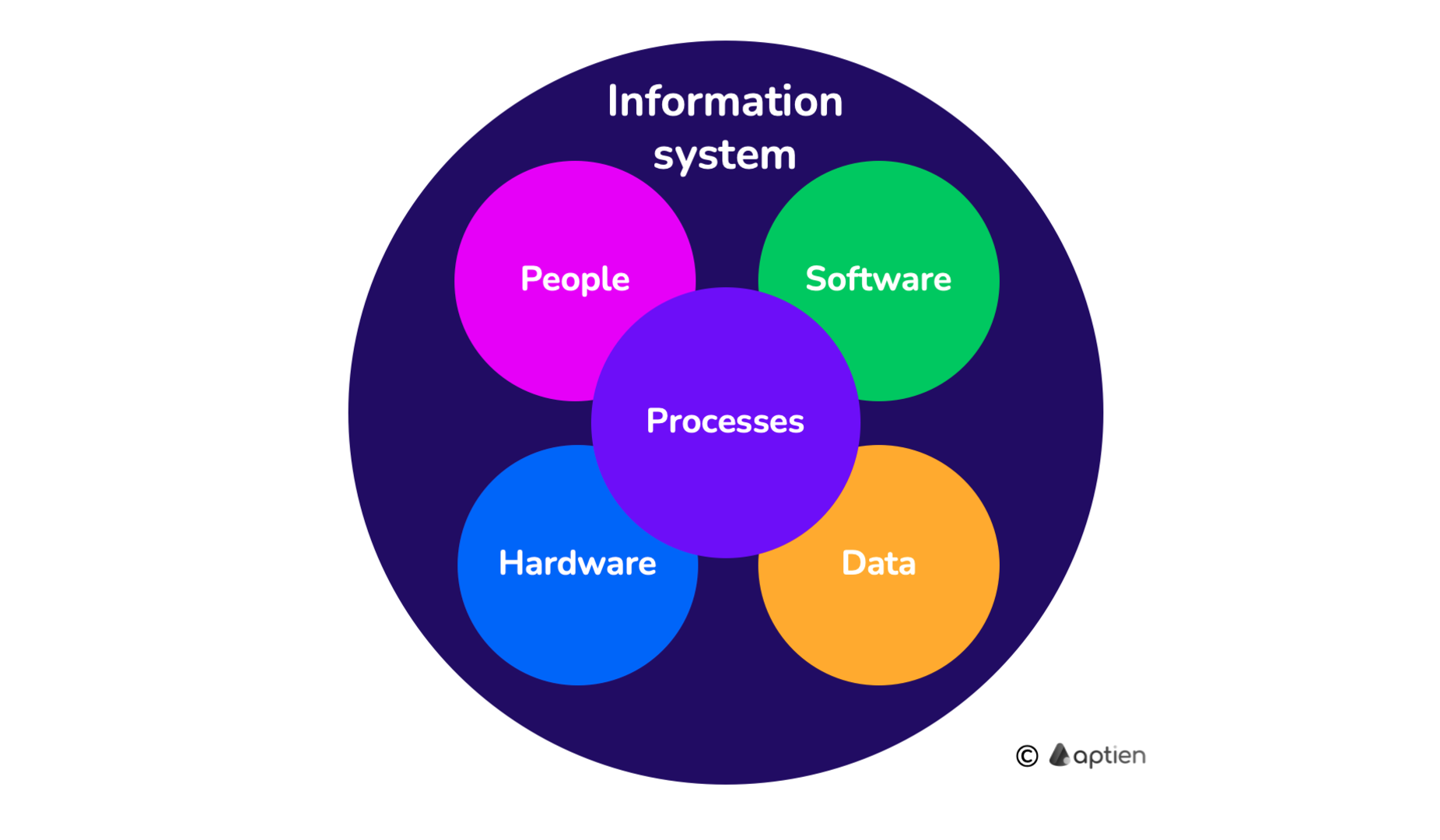
This course introduces students to the fundamental concepts of Information Systems (IS) and their role in organizations and businesses. It explains the concept of an organization, its objectives, resources, and organizational structures, as well as the relationship between an organization and its information system.
Students will learn about the main functions of an Information System: collecting, processing, storing, and distributing information to support operational activities, management, and decision-making. The course also introduces the basic concepts of information theory, including information representation, coding, information quality, and the measurement of information.
Furthermore, students will discover basic tools for information processing and decision-making, such as pseudocode, decision tables, and decision trees. An introduction to the MERISE method will help students understand the principles of information system analysis and design.
By the end of this course, students will be able to understand the role and importance of Information Systems in organizations, identify their main components and functions, and apply basic analytical tools to represent and solve simple organizational problems.
- Course creator: Houcine Belouaar
- Course creator: fouzia rajah

- Course creator: Malika Belouerghi
- Course creator: Naima BAHI
- Course creator: Yousra Benaissa
- Course creator: Salima Berima
- Course creator: Amina Bouguetitiche
- Course creator: Samir Bourekkache
- Course creator: Farah Fekraoui
Semestre: 3
Unité d’enseignement : UEF32
Matière : Programmation orientée objet 1
Crédits : 5
Coefficient : 3
Objectifs de l’enseignement :
● Initiation au paradigme orienté objet (principes et mécanismes).
● Manipulation des concepts de l’orienté objet.
● Conception de solutions orientées objet et mise en œuvre en java.
● Maitrise des éléments de base du langage java.
Objectifs du TP :
● Utiliser une partie des séances de TP pour les TD
● Pratique et mise en œuvre des concepts vus en cours sur machine.
● Un projet de TP (ou plus) englobant des aspects conceptuels et pratiques, est nécessaire pour permettre
aux étudiants de mieux comprendre les concepts étudiés.
Connaissances préalables recommandées : Connaissances de base en Algorithmique.
Contenu de la matière :
Chapitre 1 : Introduction à la POO
1. De l’impératif à l’objet : l’évolution des paradigmes de programmation
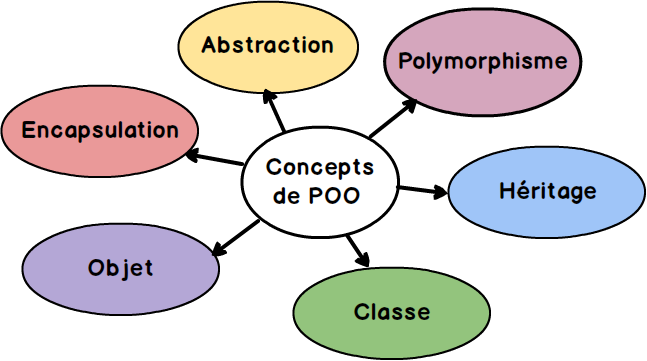
2. Fondements et philosophie de la POO : modélisation du monde réel, encapsulation, abstraction,
réutilisation, modularisation et facilitation de la maintenance du code
- Regroupement des traitements et données en POO.
- Encapsulation.
- Abstraction.
Chapitre 2 : Concepts de base de la POO
1. Notion de classe
- Structure d’une classe : attributs et méthodes
- Constructeurs des classes et initialisation des attributs.
- Encapsulation, portée des attributs et droits d’accès.
- Champs d’instance et champs de classe
2. Notion d’objet
- Définition et rôle d’un objet
- Création et manipulation d’objets
▪ Instanciation via le mot-clé new
▪ Appel de méthodes et accès aux attributs
▪ Cycle de vie d’un objet
- Références et objets
▪ Assignation d’objets à des variables
▪ Comparaison d’objets (== vs .equals())
- Relations entre objets
▪ Association
▪ Agrégation
▪ Composition
- Interaction entre objets
▪ Appel de méthodes d’un autre objet
▪ Collaboration objet-objet
▪ Passage d'objets en paramètres
Chapitre 3 : Héritage et polymorphisme
1. Héritage.
- Définition et principe de l'héritage
- Héritage simple (cas de Java)
- Héritage multiple : gestion des conflits et résolution du problème du diamant (cas de C++ et
Python)
2. Polymorphisme
- Définition et principe de polymorphisme
- Polymorphisme à l'exécution (late binding)
- Polymorphisme à la compilation (early binding)
3. Classe Object
- Rôle de la classe Object en Java
- Méthodes de la classe Object et leur héritage par défaut
- Impact sur les concepts de polymorphisme et d'héritage
Mode d’évaluation : Examen (60%), contrôle continu (40%)
Références :
1. B. Meyer, « Conception et programmation orientée objet », Edition Eyrolles, 28.
2. 2- F. Barbier, « Conception orientée objet en Java et C++ : une approche comparative », Editions Pearson
Education, Septembre 29.
3. C. Delannoy « Programmer en JAVA », Editions Eyrolles, 9eme Edition 2016.
4. Hugues Bersini, « La programmation orientée objet, cours et exercices en UML2 avec Java 5, C# 2, C++,
Python, PHP 5 et LINQ », Editions Eyrolles, 29.
- Course creator: Ammar Hamida