
Silicates are the most abundant mineral family in the Earth’s crust and the basis of nearly all mineral-based structural materials: cements and concretes, ceramics, glasses and refractories. Understanding their behavior requires mastery of the physical chemistry that governs the transformation of matter under the effect of temperature , dissolution and precipitation, nucleation and growth, sintering, melting, clinkering; as well as the interaction of these materials with their environment (water, atmosphere) and, for hydraulic binders, their hydration.
This course follows a progression from the fundamental to the applied. We first establish the thermodynamic and kinetic tools (Chapter 1), then study the central element of this chemistry, silicon (Chapter 2), before turning to silicates and their structural classification (Chapter 3), and finally silica SiO₂ and its polymorphism (Chapter 4). At each stage, structure, microstructure and application properties are linked.
- Créateur de cours: Rihana HADJEB
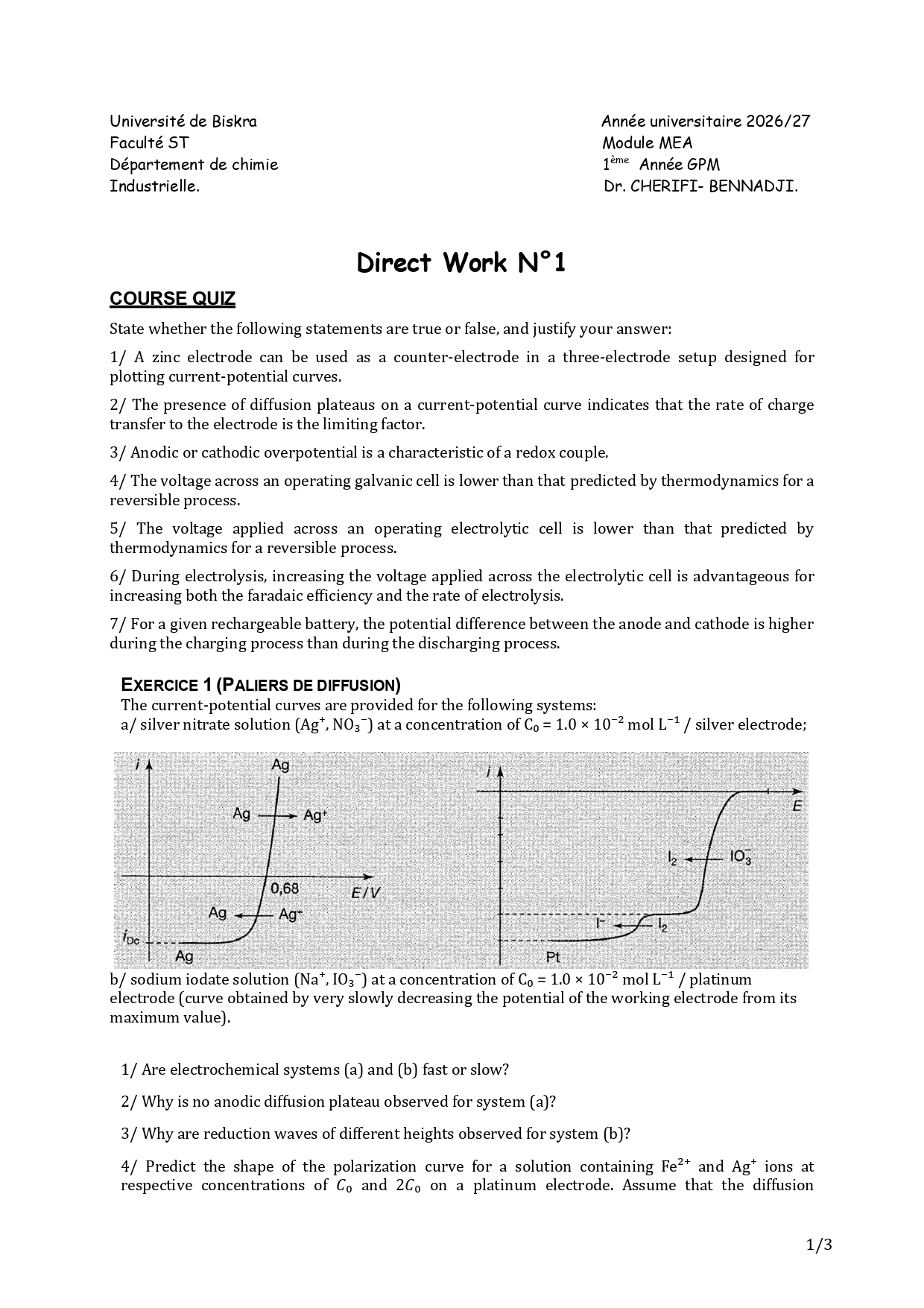
DW1
- Créateur de cours: nedjma cherifi
The fundamental characteristics of an electrochemical reaction are determined by measuring variations in current as a function of the potential applied across an electrolysis cell. The experimental determination of the relationship between current and electrode potential results in the production of graphs known as voltammograms. This is the subject of voltammetry.
The general principle of voltammetry is therefore to obtain a response (the current) from the system under study in response to the stimulus (the potential) responsible for the desired electrochemical reaction. This is achieved by scanning the electrode potential by applying and gradually varying it (potential sweep).
In order to apply the electrode potential, vary it and thereby induce electrochemical reactions, the experiment must be carried out in an electrolysis cell comprising three electrodes to which an external circuit is connected. The potential of the main electrode, where the desired reactions are to take place – known as the indicator electrode (or working electrode) – can be controlled with the aid of a reference electrode. Electrolysis then manifests itself as the flow of an electric current, the intensity of which can be measured on the external circuit using the third electrode, known as the counter-electrode (the potential of the counter-electrode generally does not need to be controlled itself). The electrode through which the current flows in the direction corresponding to a reduction process is referred to as the cathode. The other electrode, through which the current flows in the direction corresponding to an oxidation process, is referred to as the anode. Reversing the direction of the current in the circuit (during a change in potential) reverses the roles of the two electrodes.
- Créateur de cours: nedjma cherifi
- Créateur de cours: adel sakri
- Créateur de cours: adel sakri