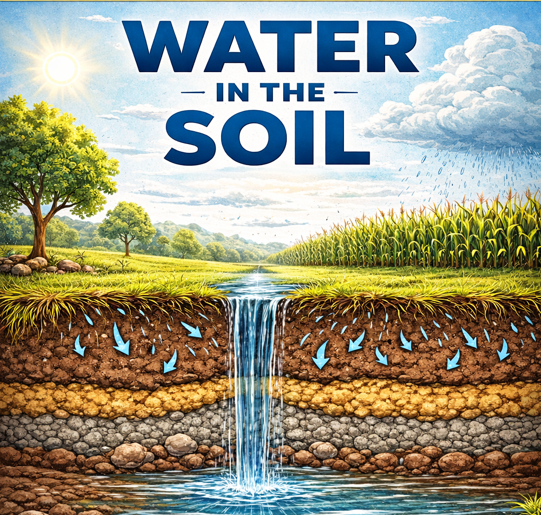
This course, designed by Dr. Ayoub Barkat for the 2025–2026 academic year at Mohamed Khider University of Biskra, provides a comprehensive and structured understanding of the behavior, distribution, and management of water in soils and subsurface environments by integrating fundamental principles of hydrology, soil science, and hydrogeology. It begins with the hydrological cycle, explaining the continuous movement of water through evaporation, precipitation, infiltration, runoff, and groundwater recharge, and emphasizes the concept of the soil water balance as a dynamic system controlled by inputs such as precipitation and irrigation and outputs such as runoff, evapotranspiration, and percolation. The course highlights the essential role of soil as a water reservoir for plant growth and agricultural productivity while examining key processes including infiltration, runoff, evaporation, and percolation, and demonstrating how soil properties such as texture, structure, and porosity influence water movement. It also addresses practical aspects of water management, including drainage systems, irrigation methods, and water conservation strategies, with the aim of improving efficiency and sustainability. Furthermore, the course introduces the fundamentals of hydrogeology, focusing on the occurrence and movement of groundwater within geological formations, and distinguishes between hydrological and hydrogeological basins. It explains hydrogeological formations based on their permeability and presents a detailed analysis of aquifer systems, including unconfined, confined, and semi confined aquifers, along with their hydraulic behavior and storage characteristics. In addition, the course examines the physical properties of soils and aquifers, such as porosity, permeability, and grain size distribution, and clarifies the differences between total and effective porosity as well as between gravity water and retention water. It also introduces important laboratory and field techniques, including grain size analysis and permeability testing, for hydrogeological characterization. A major component of the course is dedicated to groundwater flow theory based on Darcy’s Law, which establishes the relationship governing fluid flow in porous media, and includes the study of hydraulic head, hydraulic gradient, and flow velocity, along with the conditions required for the validity of this law and its practical applications in field measurements and permeability estimation. Overall, the course combines theoretical knowledge with practical applications to provide a solid foundation in soil water processes and groundwater dynamics, equipping students with the necessary tools for effective water resource management, agricultural planning, and environmental protection.
- Créateur de cours: Ayoub BARKAT

- Créateur de cours: Salah Djerouni
- Créateur de cours: Samira OUNOKI