- منشئ المقرر: Hanane DJOUAMA
- منشئ المقرر: Malika Abba
- منشئ المقرر: Malika Abba

Learning Objectives
- Identify the main environmental pollutants and their sources.
- Master sampling and sample preparation techniques.
- Understand and apply physicochemical and spectroscopic analysis methods.
- Interpret analytical results in relation to environmental standards.
- Propose strategies for monitoring and controlling environmental quality.
- منشئ المقرر: Amira Ouakkaf
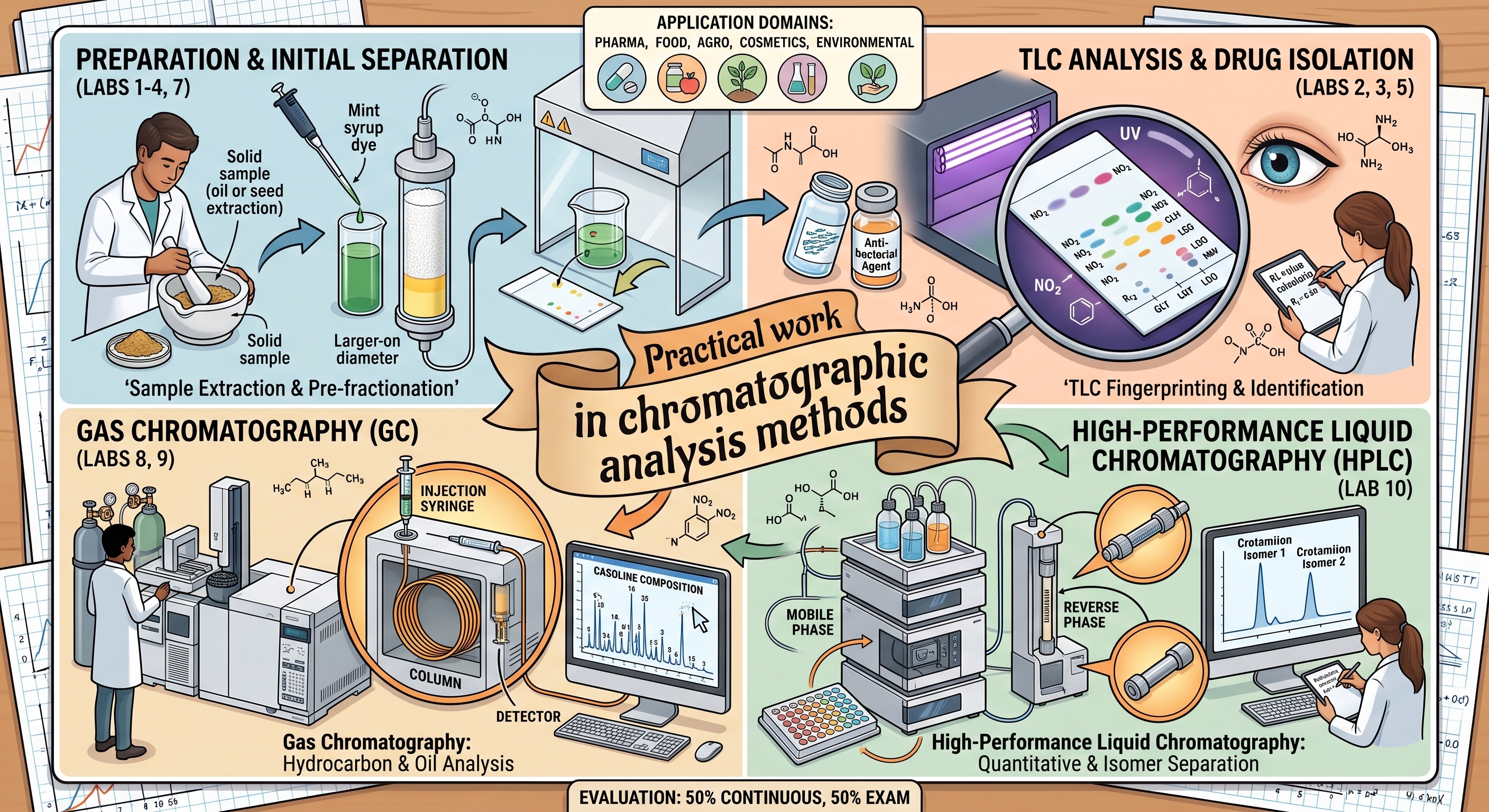
This practical work module introduces first-year Master’s students in Analytical Chemistry to core chromatographic separation and analytical techniques. Chromatography is essential for resolving and characterizing components in complex mixtures.
Through a series of practical experiments, students will gain hands-on proficiency in executing qualitative and quantitative analyses using TLC, Column Chromatography, GC, and HPLC. The curriculum emphasizes methodological workflows, chromatographic troubleshooting, and data interpretation, applied directly to real-world matrices across pharmaceutical, food science, petrochemical, and environmental chemistry.
- منشئ المقرر: imane benbrahim